
The Complete Mushroom Life Cycle: From Spore to Fruiting Mushroom
Quick Overview: Mushroom Life Cycle
Jump directly to any stage of the mushroom life cycle:
- Introduction
- What Is the Mushroom Life Cycle?
- Spore Production
- Spore Dispersal
- Germination
- Hyphal Growth
- Mycelium Formation
- Substrate Colonization
- Primordia Formation
- Pinning Stage
- Fruiting Body Development
- Sporulation
- Growth Timeline
- Growth Factors
- Mushroom vs Plant
- Conclusion
Introduction
The mushroom life cycle is one of the most fascinating biological processes in nature. What we see as a mushroom is only a small part of a much larger organism hidden underground.
This underground system, called mycelium, can spread through soil or substrate for meters and sometimes even kilometers, forming complex fungal networks.
For mushroom growers, understanding this cycle is essential for improving yield, avoiding contamination, and controlling fruiting conditions.
What Is the Mushroom Life Cycle?
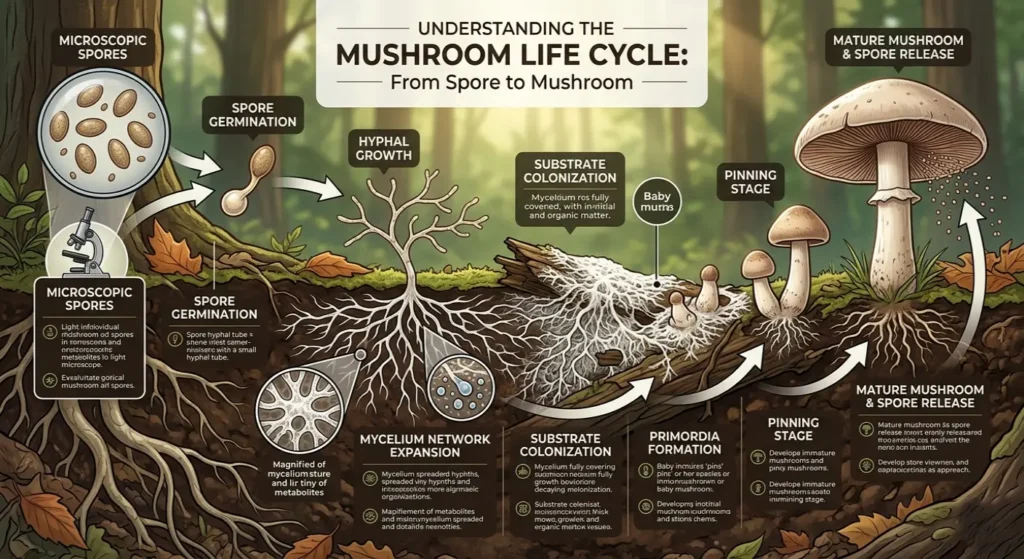
The mushroom life cycle is the biological process by which fungi grow, reproduce, and spread. Unlike plants, mushrooms do not use seeds or flowers.
Instead, they reproduce using microscopic spores, which develop into mycelium and later form fruiting bodies (mushrooms).
Stage 1: Spore Production
Mature mushrooms produce enormous quantities of spores—sometimes billions—from specialized structures under the cap.
These structures include:
- Gills (common in button mushrooms)
- Pores (seen in bolete-type mushrooms)
- Teeth or spines (in some medicinal fungi)
- Ridges or folds
Each spore contains genetic information needed to create a new fungal organism.
Stage 2: Spore Dispersal
Once released, spores spread through natural and environmental forces such as:
- Wind currents
- Rain splash
- Insects and small animals
- Human handling or movement
Most spores never survive, which is why fungi produce them in such large numbers.
Stage 3: Germination
When a spore lands in a suitable environment, it absorbs moisture and begins germination.
Required conditions:
- Moisture
- Oxygen
- Stable temperature
- Nutrient-rich substrate
The spore then produces its first hypha.
Stage 4: Hyphal Growth
Hyphae are microscopic thread-like structures that extend outward through the substrate.
They are responsible for exploring the environment and absorbing nutrients from organic matter.
At this stage, the fungus is invisible but actively growing.
Stage 5: Mycelium Formation
As hyphae branch and connect, they form a dense network called mycelium, which is the true body of the fungus.
Functions of mycelium:
- Breaks down organic matter
- Absorbs nutrients
- Stores energy
- Communicates within fungal network
- Prepares for fruiting
Mycelium can survive for years under the right conditions.
Stage 6: Substrate Colonization
During colonization, mycelium spreads through the entire substrate and consumes available nutrients.
Healthy colonization signs:
- Bright white and dense growth
- Even coverage across substrate
- Fast and consistent expansion
- No contamination or odor
Common problems:
- Green mold contamination
- Bacterial wet spots
- Poor ventilation
- Incorrect temperature range
Stage 7: Primordia Formation
Once fully colonized, the mycelium responds to environmental triggers and forms small dense knots called primordia.
These are the earliest stage of mushroom development and are often called “mushroom embryos.”
Stage 8: Pinning Stage
Primordia develop into small mushroom structures known as pins.
This is the first stage where mushrooms become visible.
Pinning is triggered by:
- Fresh air exchange (FAE)
- Increased humidity
- Light exposure
- Temperature drop or environmental change
This is one of the most critical stages for growers.
Stage 9: Fruiting Body Development
During this stage, pins rapidly expand into mature mushrooms.
Key changes include:
- Cap expansion
- Stem elongation
- Gill or pore development
- Rapid size increase
Some species can double in size within 24 hours under ideal conditions.
Stage 10: Sporulation
When mushrooms fully mature, they begin releasing spores into the environment.
This completes the life cycle and allows the process to begin again.
How Long Does the Mushroom Life Cycle Take?
| Stage | Duration |
|---|---|
| Germination | 2–14 days |
| Colonization | 2–6 weeks |
| Pinning | 3–10 days |
| Fruiting | 5–14 days |
Total cycle time varies depending on species, genetics, and environmental conditions.
Factors That Affect Mushroom Growth
- Temperature stability
- Humidity levels
- Fresh air exchange
- Substrate nutrition
- Genetic strain quality
Mushroom Life Cycle vs Plant Life Cycle
| Mushroom | Plant |
|---|---|
| Grows from spores | Grows from seeds |
| Uses mycelium network | Uses roots |
| Absorbs nutrients externally | Uses photosynthesis |
| Produces fruiting bodies | Produces flowers/fruits |
Conclusion
The mushroom life cycle is a complex yet beautifully organized biological process that transforms microscopic spores into fully developed fruiting mushrooms.
By understanding each stage, growers can significantly improve yield quality, reduce contamination, and optimize their cultivation systems.
The mushroom life cycle is the process through which fungi grow, reproduce, and spread, beginning with spores and ending with spore production by mature mushrooms.
Depending on the species and growing conditions, the mushroom life cycle can take anywhere from a few weeks to several months.
Mycelium is the vegetative part of a fungus, consisting of a network of microscopic hyphae that absorb nutrients and support mushroom growth.
Mushrooms reproduce by releasing microscopic spores that can germinate and develop into new fungal colonies.